Showing posts with label Stuart. Show all posts

Thursday, September 28, 2006

Charles II (30 Jan 1649 - 6 Feb 1685) Coinage And History
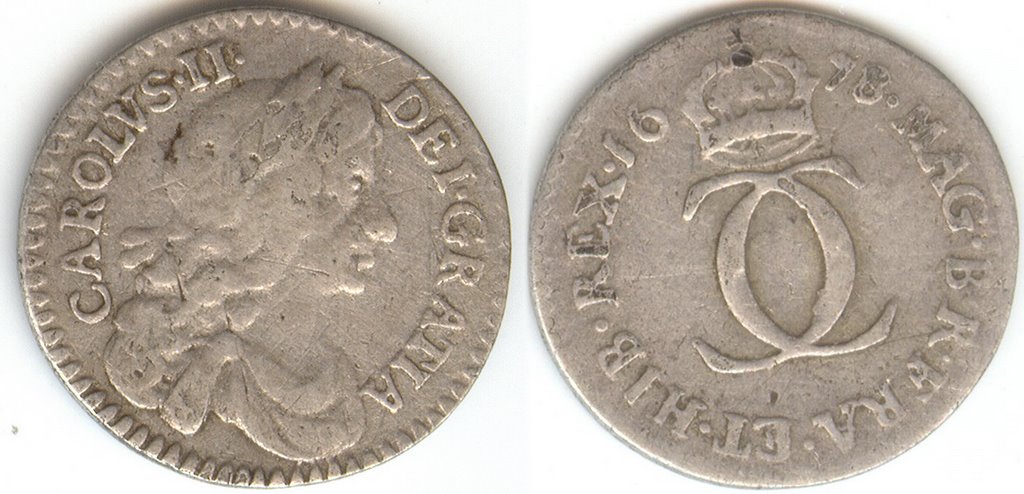


As yesterday, I Showed some Charles I coins, I thought it would make some sense to show one from when his son Charles II was restored to The Monarchy. The following coin is a Charles II twopence from 1678 along with some background information.


HOUSE OF STUART


Charles II (30 Jan 1649 - 6 Feb 1685) - born 29th May 1630 - one marriage with no offspring


Several ill fated attempts to regain his inheritance from his father failed, as his armies were routed by the well organised Cromwell. A young Charles had to flee the country as the power of the Commonwealth steadily but surely took over, famously hiding in an oak tree en route to France. The restoration of the monarchy was negotiated by General George Monk who called for new elections, following a revival of royalist feeling in 1660. Charles II ascended to the throne after being recalled from his exile and the Restoration began on 29th May 1660. He was married in 1662 to Catherine Henrietta daughter of John IV Duke of Braganza, but failed to produce an heir. He did have sixteen illegitimate issue though after amorous affairs with various women including Nell Gwynn and Louise, duchess of Portsmouth. Charles was a keen horseman and actually rode several winners at Newmarket himself. He died aged 54 from complications following a stroke.

His reign was most important numismatically for the permanent introduction of machine made “milled” coinage from 1662 and for the introduction of a copper regal coinage of halfpennies and farthings from 1672 after the withdrawal of tradesman’s tokens. The hammered coinage finished being produced in early 1662, and the Roettier family designed the new coinage replacing Thomas Simon who was relegated to designing only the small silver coins and medallions. The major new milled denomination was the Guinea with it’s multiples and fractions which was valued at this time at twenty shillings. The silver denominations were the same as for Cromwell with the Sixpence in addition with the small silver from groat to penny. Some of the silver shillings have a plume on the centre of the reverse sometimes with a plume on the obverse as a mint mark, this indicates the silver came from Wales. Some of the gold coinage has an elepant below the bust indicating the gold came from Guinea in Africa.

Wednesday, September 27, 2006

Charles I (27 March 1625 - 30 Jan 1649) Coinage And History


Charles I (27 March 1625 - 30 Jan 1649) Coinage And History

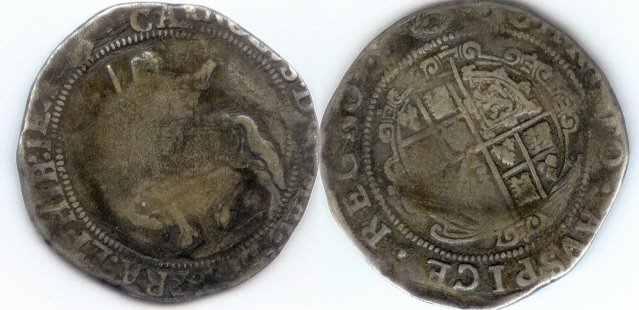
The following two images are a Halfcrown of Charles I Eye Mintmark that dates it to 1645 Tower Mint Under parliament, even though it looks worn, it's in a rather good state for it's age as that at that time because of the war, it was common for the coinage to have problems with the control of standards.

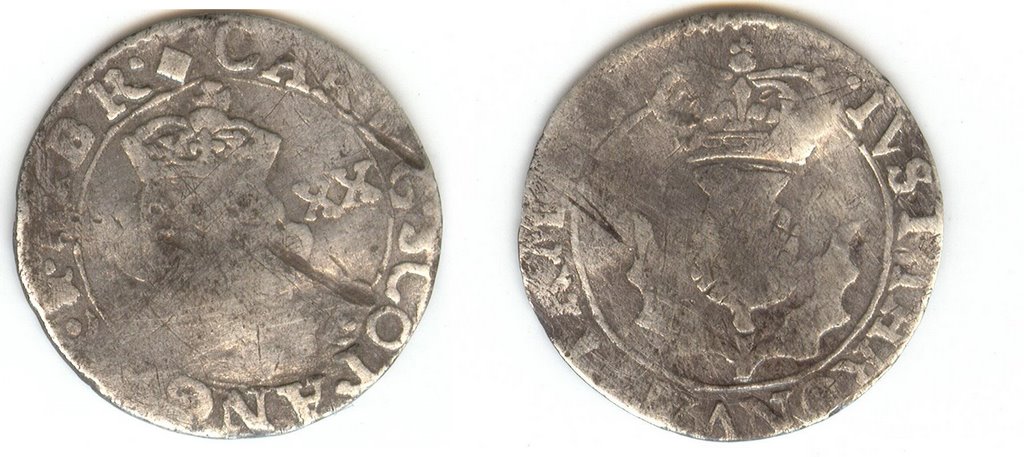
The Second image is of a Charles I Scottish Twenty Shilling, Thistle Mintmark the most probable identification would be Spink 5590 or 5591. Third coinage (1637- 42), bust of new style. My guess is 5590, which is described as 'bust wholly within inner circle, F over crown on rev' or 5591, no F on reverse, but it's difficult to tell due to wear. Even though it's worn it's easy to tell that the quality is better for a hammered coin from this time period, The betterstriking was perhaps a combination of the fact that the Master of the Mint was Nicholas Briot (from 1636 to 1642) and that the coins were produced on a screw press. Later his son-in-law John Falconer took over the role. Some further history can be found below.

Charles I (27 March 1625 - 30 Jan 1649) - born 19 November 1600 - one marriage with nine offspring

Charles I the second son of James I had a weak and sickly childhood and was of quite small stature. He inherited a weak inflationary economy due to the influx of gold and silver from America, and impoverished it by his extravagance. He was deposed for disregarding Parliament, trying to arrest five members and unwisely levying taxes without its consent. This caused the emergence of a radical republican army under the command of Oliver Cromwell. Charles had to leave London relying on traditional Royalist strongholds like Oxford. This means that the coinage of Charles I is one of the most complicated and fascinating in the entire British series, with the great number of provincial Royalist issues and the intriguing Obsidonal coinages from the City’s under siege.

Charles was captured in 1648 and was beheaded at the Mansion House on Whitehall in 1649 aged 48. He famously gave Bishop Juxon a large gold five pound piece as a last act on the scaffold and this has become known as the Juxon Medal and is on display in the British Museum.The reign is one of the most diverse and interesting numismatically ranging from the fine machine made coins of Nicholas Briot to the crudely struck siege pieces of the Civil War struck on old silver plate. Branch Mints were set up around the country starting with Aberystwyth in 1637. The Farthing issues continued under the Duchess of Richmond and Lord Maltravers, finishing in 1644 when the licence was revoked by Parliament.

At the other end of the spectrum were the silver Pounds, the largest British coins ever minted, and the magnificent gold Triple Unites, the largest gold coins ever produced. Many different locations in England and Wales had their own mints throughout the reign and during Civil War. The provincial mints are Aberystwyth, Asbhy, Bridgnorth, Bristol, Chester, Exeter, Hartlebury Castle, Hereford, Oxford, Shrewsbury, Truro, Worcester, York, and the siege mints of Carlisle, Newark, Scarborough and Pontefract. With the large number of mints and denominations coupled with the troubled times during the reign, this equates to an enormous number of different coinages, showing the history and movements of the King in a very unusual period.