Showing posts with label Treasure. Show all posts

Thursday, March 19, 2009

Odyssey Marine Shipwreck Holds 200,000 Gold Coins


Odyssey Marine has started work on another shipwreck that could hold about four tons of gold the full story follows below.

Odyssey Marine, the southern Florida shipwreck experts that have found more coin treasures than any other salver, has discovered the wreck of HMS Victory, it was announced Feb 2.

HMS Victory sank in the English Channel on Oct. 4, 1744, taking 1,150 sailors and four tons of Portuguese gold to the bottom of Davy Jones' locker.

About 200,000 gold coins are believed to be part of the treasure, whose sinking caused a major embarrassment to King George II in 1744, and whose recovery in 2009 could well become a cause celebre in international legal circles.

The wreckage of the HMS Victory, found below about 330 feet of water, may carry an even bigger jackpot than the $500 million in sunken treasure discovered two years ago off the coast of Spain.

Research indicates the HMS Victory was carrying 4 tons of gold coins when it sank in storm, said Greg Stemm, co-founder of Odyssey Marine Exploration, ahead of a Feb. 2 news conference in London.

So far, two brass cannons have been recovered from the wreck, Stemm said. The Florida-based company said it is negotiating with the British government over collaborating on the project.

"This is a big one, just because of the history,'' Stemm said. "Very rarely do you solve an age-old mystery like this.''

Thirty-one brass cannons and other evidence on the wreck allowed definitive identification of the HMS Victory, the 175-foot (53-meter) sailing ship that was separated from its fleet and sank in the English Channel on Oct. 4, 1744, with at least 900 men aboard, the company said. The ship was the largest and, with 110 brass cannons, the most heavily armed vessel of its day. It was the inspiration for the HMS Victory famously commanded by Adm. Horatio Nelson decades later.

Odyssey was searching for other valuable shipwrecks in the English Channel when it came across the Victory. Stemm wouldn't say exactly where the ship was found for fear of attracting plunderers, though he said it wasn't close to where it was expected.

"We found this more than 50 miles (80 kilometers) from where anybody would have thought it went down,'' Stemm said.

Federal court records filed by Odyssey in Tampa seeking the exclusive salvage rights said the site is 25 miles to 40 miles (40 kilometers to 64 kilometers) from the English coast, outside of its territorial waters. Odyssey Marine has previously discovered vessels with treasure that sailed under the flags of Spain, Peru, England and others.

In order to assert ownership, Odyssey Marine commenced an action in the U.S. District Court for the Middle District of Florida, located in Tampa. The technical term is to "arrest" the vessel, a principal whereby the salver recovers some portion of the ship or its cargo and brings it before the court. In this case, it was a brass cannon.

The Victory - the same name was used for Lord Nelson's shop at Trafalgar generations later - is only called an "Unidentified vessel" in the title of the complaint, the better to confuse those who might seek to take the treasure from under the noses of the competition - other treasure salvers.

Odyssey's claims for salvage rights for other vessels were asserted under either international law of the sea or the law of salvage, which sometimes conflict. They are litigating against the Kingdom of Spain and Republic fo Peru over Spanish galleons found after a shipwreck in the 17th century.

English shipwrecks have a common law background, different from the civil law of Spanish countries, which reserve treasure to the sovereign - and provide that it cannot be salvaged without the consent of Her Majesty's government. On another less important wreck, Odyssey got to keep 80 percent of the first $50 million in salvage value on a diminishing scale until above $500 million the profits would be split 50-50.

Under international maritime law and the law of the sea, going back to the time of Hugo Grotius in the year 1600, when an owner of a vessel abandons it, it may be claimed by anyone who finds it. When it is not abandoned, a wreck may be salvaged by anyone who claims it ("arrests" the wreck, in the arcane language of admiralty law).

They may not necessarily be able to keep the goods, but must be compensated for the salvage work that they have done the payment can be quite liberal - if there is a right to work the vessel and its treasure in the first place.

In most instances, available technology at the time the ships surrendered to the depths limited the ability to salvage the ships, rescue persons or property. The situation with the Mercedes (another Odyssey litigation with Spain) is also similar to more than 600 other Spanish wrecks that are known to have populated the East Coast of the United States.

This very factor, and the wreck of other ships, prompted the U.S. Congress in 1987 to try and regulate control over the marine tragedies that took place inside the three-mile limit. Essentially, they were ruled to be owned by the United States, which in turn delegated the ownership to the individual states.

The Victory is located in the English Channel, about 60 miles from its last reported position which solved a historical mystery - and Odyssey claims that no nation has the right to regulate who can salvage it. The British Foreign Office disagrees.

Regardless of the state or nation involved, the general principals of law are essentially the same. When sunken ships or their cargo are rescued from the bottom of the ocean by those other than the owners, courts generally favor applying the law of salvage over the law of finds.

"Finds" can be summed up by that childish taunt, "Finder's keepers".

Finds law is generally applied, however, where the previous owners are found to have abandoned their property. Abandonment must be proved to the Court's satisfaction by clear and convincing evidence, typically by an owner's express declaration abandoning title. (It can be proved indirectly through actions, too).

In some instances, a commercial shipments of gold may be insured, and the underwriters are usually asked to promptly pay the claims. The payment of the claims vests title to the gold in the underwriters, who can no more salvage the boat than the government can.

The position of the Department of State, as expressed in a Report of the House of Representatives in 1988 is that "the U.S. only abandons its sovereignty over, and title to, sunken U.S. warships by affirmative act; mere passage of time or lack of positive assertions of right are insufficient to establish such abandonment."

A 1902 treaty of friendship and commerce with Spain provided the key that the Court will look to: "Spanish vessels can ... be abandoned only by express renunciation. Both Spain and the United States agree that this treaty provision requires that in our territorial waters Spanish ships are to be accorded the same immunity as United States.

So the shipwreck of the century is headed to Tampa and court, where it will all be sorted out in the coming months. Meanwhile, the salvers will be looking for the coins that they know are on board, under 300 feet of the English channel and many pages of history.


Digg!

Friday, February 06, 2009

Odyssey Marine Finds More Coins


Odyssey Marine has found another wreck only time will tell if legal issues don't tie this one up as well. The Full article follows below. Let me know what you think should they be searching these wrecks? Also do you think this one will get tied up in the courts like some of the others?

Odyssey Marine, the southern Florida concern that has found more coin treasurers than any other salver, has a new discovery as of Feb. 2: the wreck of HMS Victory, which sank in the English Channel on Oct. 4, 1744 taking 1,150 sailors and four tons of Portuguese gold to the bottom of Davy Jones's locker.

About 200,000 gold coins are believed to be part of the treasure, whose sinking caused a major embarrassment to King George II in 1744, and whose recovery in 2009 could well become a cause celebre in international legal circles.

The wreckage of the HMS Victory, found below about 330 feet of water, may carry an even bigger jackpot than the $500 million in sunken treasure discovered two years ago off the coast of Spain.

Research indicates the HMS Victory was carrying 4 tons of gold coins when it sank in storm, said Greg Stemm, co-founder of Odyssey Marine Exploration, ahead of a Monday news conference in London.

So far, two brass cannons have been recovered from the wreck, Stemm said. The Florida-based company said it is negotiating with the British government over collaborating on the project.

"This is a big one, just because of the history,'' Stemm said. "Very rarely do you solve an age-old mystery like this.''

Thirty-one brass cannons and other evidence on the wreck allowed definitive identification of the HMS Victory, 175-foot (53-meter) sailing ship that was separated from its fleet and sank in the English Channel on Oct. 4, 1744, with at least 900 men aboard, the company said. The ship was the largest and, with 110 brass cannons, the most heavily armed vessel of its day. It was the inspiration for the HMS Victory, famously commanded by Adm. Horatio Nelson decades later.

Odyssey was searching for other valuable shipwrecks in the English Channel when it came across the Victory. Stemm wouldn't say exactly where the ship was found for fear of attracting plunderers, though he said it wasn't close to where it was expected.

"We found this more than 50 miles (80 kilometers) from where anybody would have thought it went down,'' Stemm said.

Federal court records filed by Odyssey in Tampa seeking the exclusive salvage rights said the site is 25 miles to 40 miles (40 kilometers to 64 kilometers) from the English coast, outside of its territorial waters. Odyssey Marine has previously discovered vessels with treasure that sailed under the flags of Spain, Peru, England and others.

In order to assert ownership, Odyssey Marine commenced an action in the U.S. District Court for the Middle District of Florida, located in Tampa. The technical term is to "arrest" the vessel, a principal whereby the salver recovers some portion of the ship or its cargo and brings it before the court. In this case, it was a brass cannon.

The Victory the same name was used for Lord Nelson's shop at Trafalgar generations later is only called an "Unidentified vessel" in the title of the complaint, the better to confuse those who might seek to take the treasure from under the noses of the competition other treasure salvers.

Odyssey's claims for salvage rights for other vessels were asserted under either international law of the sea or the law of salvage, which sometimes conflict. They are litigating against the Kingdom of Spain and Republic fo Peru over Spanish galleons found after a shipwreck in the 17th century.

English shipwrecks have a common law background, different from the civil law of Spanish countries, which reserve treasure to the sovereign and provide that it cannot be salvaged without the consent of Her Majesty's government. On another less important wreck, Odyssey got to keep 80 percent of the first $50 million in salvage value on a diminishing scale until above $500 million the profits would be split 50-50.

Under international maritime law and the law of the sea, going back to the time of Hugo Grotius in the year 1600, when an owner of a vessel abandons it, it may be claimed by anyone who finds it. When it is not abandoned, a wreck may be salvaged by anyone who claims it ("arrests" the wreck, in the arcane language of admiralty law).

They may not necessarily be able to keep the goods, but must be compensated for the salvage work that they have done the payment can be quite liberal if there is a right to work the vessel and its treasure in the first place.

In most instances, available technology at the time the ships surrendered to the depths limited the ability to salvage the ships, rescue persons or property. The situation with the Mercedes (another Odyssey litigation with Spain) is also similar to more than 600 other Spanish wrecks that are known to have populated the East Coast of the United States.

This very factor, and the wreck of other ships, prompted the U.S. Congress in 1987 to try and regulate control over the marine tragedies that took place inside the three-mile limit. Essentially, they were ruled to be owned by the United States, which in turn delegated the ownership to the individual states.

The Victory is located in the English Channel, about 60 miles from its last reported position which solved a historical mystery and Odyssey claims that no nation has the right to regulate who can salvage it. The British Foreign Office disagrees.

Regardless of the state or nation involved, the general principals of law are essentially the same. When sunken ships or their cargo are rescued from the bottom of the ocean by those other than the owners, courts generally favor applying the law of salvage over the law of finds.

"Finds" can be summed up by that childish taunt, "Finder's keepers".

Finds law is generally applied, however, where the previous owners are found to have abandoned their property. Abandonment must be proved to the Court's satisfaction by clear and convincing evidence, typically by an owner's express declaration abandoning title. (It can be proved indirectly through actions, too).

In some instances, a commercial shipments of gold may be insured, and the underwriters are usually asked to promptly pay the claims. The payment of the claims vests title to the gold in the underwriters, who can no more salvage the boat than the government can.

The position of the Department of State, as expressed in a Report of the House of Representatives in 1988 IS that "the U.S. only abandons its sovereignty over, and title to, sunken U.S. warships by affirmative act; mere passage of time or lack of positive assertions of right are insufficient to establish such abandonment".

A 1902 treaty of friendship and commerce with Spain provided the key that the Court will look to: "Spanish vessels can ... be abandoned only by express renunciation. Both Spain and the United States agree that this treaty provision requires that in our territorial waters Spanish ships are to be accorded the same immunity as United States.

So the shipwreck of the century is headed to Tampa and court where it will all be sorted out in the coming months. Meanwhile, the salvers will be looking for the coins that they know are on board, under 300 feet of the English channel and many pages of history.

Digg!

Friday, July 20, 2007

10th Century Viking Hoard Found ( Part II)


Digg!

10th Century Viking Hoard Found


I thought people might be interested in this story if they have not all
ready heard about it on the news. I hope you enjoy it and find it as
interesting as I do. I can't wait to see some images of the new coin
types. The obove picture shows the hoard find but not individual coins the picture is from the British Musuem via AP

The most important Viking treasures to be discovered in Britain for 150 years have been unearthed by a father and son while metal detecting in North Yorkshire.

David and Andrew Whelan uncovered the hoard, which dates back to the 10th century, in Harrogate. The British Museum said yesterday that the treasures were of global significance and could shed new light on the period.

Andrew Whelan, 35, said it had initially felt like an unlucky day when they drove out to the countryside with their metal detectors one Saturday morning in January.

He and his father, 65, had been turned away from two farms and had had a squabble before reluctantly visiting a field as a "last resort" because they had only ever discovered buttons there.

The pair then unearthed a bundle which included 617 silver coins, a gold arm-ring and a gilt silver vessel so rare it is only the second of its kind ever to be found in Britain, and is among six or seven in Europe.

Mr Whelan Jnr, who has been metal detecting for six years, said it quickly became apparent they had stumbled upon an extraordinary find.

"My father got a strong signal and a cup tumbled out after a couple of scoops of earth. There was a coin sat on top of this bundle. We knew then it was something big and we were shaking with excitement as we lifted it out," he said.

After transporting the hoard to their home, they left it on their kitchen counter while they went to report it to their local finds liaison officer in Leeds. It was transferred to the British Museum where conservators carefully examined each item over months.

It is thought that the treasure was buried for safekeeping by a wealthy Viking leader during the unrest that followed the conquest of the Viking kingdom of Northumbria in AD 927 by the Anglo-Saxon king Athelstan (924-39).

One of the coins, which bears the Latin inscription, Rex Tiotius Britanniae, dating to 927, is the earliest indication of Britain being under one ruler, at a time when the country was split between Viking and Anglo-Saxon control. The medieval objects were found to have come from Afghanistan, Russia, Scandinavia and continental Europe.

The gilt vessel, made in France in the first half of the ninth century, has roundels inscribed with seven animals around it, and was believed to have been intended for use in church services. It was probably looted from a monastery by Vikings or given to them in tribute.

Most of the smaller objects were hidden inside the vessel. The coins included several new and rare types, suggesting that there were more mints in the country than previously thought.

The coroner, Geoff Fell, declared the hoard as a treasure, at a court hearing in Harrogate. "Treasure cases are always interesting, but this is one of the most exciting cases that I have ever had to rule on. I'm delighted that such an important Viking hoard has been discovered in North Yorkshire. We are extremely proud of our Viking heritage in this area," he said.

Margaret Hodge, the Culture minister, added: "Finds such as this are invaluable in teaching us about our history. I commend David and Andrew Whelan for their prompt and responsible reporting of this hugely significant find, which will enrich our understanding of the Vikings."

The hoard will be valued and then the British Museum and York Museum Trust plan to appeal to the Heritage Lottery Fund for its acquisition so they can exhibit it.

The Vikings in Britain

* In the year 793, Viking pirate raiders sailed across the North Sea to attack a Christian monastery at Lindisfarne in north-east England and pillage the surrounding area. Viking raids spread across Britain soon afterwards.

* In 865, a huge army of Danish Vikings invaded England. The fighting went on for several years.

* Vikings conquered all of northern, central and eastern England, and seized much of the land for their own farms. They called the area The Danelaw.

* In the ninth century, Norwegian Vikings sailed to northern and western Scotland and seized land. They also settled on the Isle of Man and Wales.

Saturday, May 19, 2007

Shipwreck Treasure Found Part II


It looks like the secracy will go one for a bit here is a report for today where they speculate that the shipwreck find was off the coast of Corwall, so now we have two places either off the coast of Flordia or Corwall another interesting thing was the stock for the company clossed out yesterday up by Eighty Percent.


Odyssey Marine Exploration Stock

So all in all this is going to be fun to follow.


Record wreck 'found off Cornwall'

The haul was salvaged using a tethered underwater robot

The haul of coins

A record haul of half a million silver and gold coins from a 17th Century shipwreck may have been found just 40 miles from Land's End, an expert said.
US treasure hunters said the coins, worth an estimated $500m (£253m), were recovered in the Atlantic Ocean.

But Odyssey Marine Exploration, who described it as the largest find of its kind, refused to pinpoint the location.

US coin expert Dr Lane Brunner said there was evidence the shipwreck was lying off the Cornish coast.

Dr Brunner, from the American Numismatic Association, told Five Live there were clues about the location in a statement given to a US federal court in the autumn.

"They told a judge at that point that they had found the wreck of a seventeenth-century merchant ship in the Atlantic Ocean, just outside the English Channel - about 40 miles off Lands' End.


So all we can do is add two and two together
Dr Lane Brunner


"So all we can do is add two and two together. It would seem logical given the timing and everything that could be the site."

In 1641, an English ship called the Merchant Royal sank off the Scilly Islands, laden with bullion from Mexico. There is speculation that this is the wreck salvaged by Odyssey.

'Dazzling specimens'

Odyssey said it had kept the location secret because of security and legal reasons.

"The gold coins are almost all dazzling mint state specimens," Odyssey co-founder Greg Stemm said.

The artefacts, including more than 17 tonnes of silver coins plus a few hundred gold coins, have been shipped to the US and are being examined by experts at an undisclosed location.


The mammoth haul was salvaged using a tethered underwater robot.

Odyssey, which used the code name Black Swan, said it expected the wreck to become one of the "most publicised in history".

It said the site was of huge historical importance because of the insight it would offer into seafaring and the social life of the period when the ship sank.

"Our research suggests that there were a number of colonial period shipwrecks that were lost in the area where this site is located, so we are being very cautious about speculating as to the possible identity of the shipwreck," said John Morris, Odyssey's co-founder.

"We have treated this site with kid gloves and the archaeological work done by our team out there is unsurpassed.

"We are thoroughly documenting and recording the site, which we believe will have immense historical significance," he said.

Odyssey said the coins were recovered in international waters, "beyond the legal jurisdiction of any country", and had been legally imported into the US.

Friday, May 18, 2007

Shipwreck Treasure Found


This is interesting wish they could release more
details about what coins they found or what ship it
might be. I hope the respect the archaeological
aspects of the site as well. It could be very exceptional if it is a
British Ship.


I hope you find it interesting, as I think we will
probably see these coins at some point on the market.


TAMPA, Fla. - Deep-sea explorers said Friday they have
mined what could be the richest shipwreck treasure in
history, bringing home 17 tons of colonial-era silver
and gold coins from an undisclosed site in the
Atlantic Ocean. Estimated value: $500 million.


A jet chartered by Tampa-based Odyssey Marine
Exploration landed in the United States recently with
hundreds of plastic containers brimming with coins
raised from the ocean floor, Odyssey co-chairman Greg
Stemm said. The more than 500,000 pieces are expected
to fetch an average of $1,000 each from collectors and
investors.


"For this colonial era, I think (the find) is
unprecedented," said rare coin expert Nick Bruyer, who
examined a batch of coins from the wreck. "I don't
know of anything equal or comparable to it."


Citing security concerns, the company declined to
release any details about the ship or the wreck site
Friday. Stemm said a formal announcement will come
later, but court records indicate the coins might come
from a 400-year-old ship found off England.


Because the shipwreck was found in a lane where many
colonial-era vessels went down, there is still some
uncertainty about its nationality, size and age, Stemm
said, although evidence points to a specific known
shipwreck. The site is beyond the territorial waters
or legal jurisdiction of any country, he said.


"Rather than a shout of glee, it's more being able to
exhale for the first time in a long time," Stemm said
of the haul, by far the biggest in Odyssey's 13-year
history.


He wouldn't say if the loot was taken from the same
wreck site near the English Channel that Odyssey
recently petitioned a federal court for permission to
salvage.


In seeking exclusive rights to that site, an Odyssey
attorney told a federal judge last fall that the
company likely had found the remains of a 17th-century
merchant vessel that sank with valuable cargo aboard,
about 40 miles off the southwestern tip of England. A
judge signed an order granting those rights last
month.


In keeping with the secretive nature of the project
dubbed "Black Swan," Odyssey also isn't talking yet
about the types, denominations and country of origin
of the coins.


Bruyer said he observed a wide range of varieties and
dates of likely uncirculated currency in much better
condition than artifacts yielded by most shipwrecks of
a similar age.


The Black Swan coins - mostly silver pieces - likely
will fetch several hundred dollars to several thousand
dollars each, with some possibly commanding much more,
he said. Value is determined by rarity, condition and
the story behind them.


Controlled release of the coins into the market along
with their expected high value to collectors likely
will keep prices at a premium, he said.


The richest ever shipwreck haul was yielded by the
Spanish galleon Nuestra Senora de Atocha, which sank
in a hurricane off the Florida Keys in 1622.
Treasure-hunting pioneer Mel Fisher found it in 1985,
retrieving a reported $400 million in coins and other
loot.


Odyssey likely will return to the same spot for more
coins and artifacts.


"We have treated this site with kid gloves and the
archaeological work done by our team out there is
unsurpassed," Odyssey CEO John Morris said. "We are
thoroughly documenting and recording the site, which
we believe will have immense historical significance."


The news is timely for Odyssey, the only publicly
traded company of its kind.


The company salvaged more than 50,000 coins and other
artifacts from the wreck of the SS Republic off
Savannah, Ga., in 2003, making millions. But Odyssey
posted losses in 2005 and 2006 while using its
expensive, state-of-the-art ships and deep-water
robotic equipment to hunt for the next mother lode.


"The outside world now understands that what we do is
a real business and is repeatable and not just a lucky
one shot deal," Stemm said. "I don't know of anybody
else who has hit more than one economically
significant shipwreck."


In January, Odyssey won permission from the Spanish
government to resume a suspended search for the wreck
of the HMS Sussex, which was leading a British fleet
into the Mediterranean Sea for a war against France in
1694 when it sank in a storm off Gibraltar.


Historians believe the 157-foot warship was carrying
nine tons of gold coins to buy the loyalty of the Duke
of Savoy, a potential ally in southeastern France.
Odyssey believes those coins could also fetch more
than $500 million.


But under the terms of a historic agreement Odyssey
will have to share any finds with the British
government. The company will get 80 percent of the
first $45 million and about 50 percent of the proceeds
thereafter.

Tuesday, October 03, 2006

Treasure Trove Warning Over E-Bay

Treasure Trove Warning Over E-Bay

This story I found to be interesting as it could have a very big effect on what we may see for auction in the future, as I'm not sure how many people knew of the law and I don't think it was really being enforced.

People who find treasure may be breaking the law if they do not report it to the authorities, eBay and the British Museum are warning.
The museum has set up a specialist team - under its Portable Antiquities Scheme (PAS) - to make sure antiques are legally sold by eBay sellers.
Some traders in archaeological finds are unaware they may have to be declared under the Treasure Act.

Illegal listings will be reported to specialist Met Police detectives.
English, Welsh and Northern Irish archaeological finds which constitute "treasure" must be reported to the local coroner or the PAS under the Treasure Act.
Metallic objects made up of at least 10% gold or silver which are at least 300 years old are classed as treasure.

"There are definitely some people who know perfectly well what they're doing" British Museum


Some coins with lower amounts of gold or silver could also be classed as treasure.
Failure to report finds deemed to be treasure is a criminal offence under the act.
Items spotted by the PAS being sold on eBay illegally have included gold and silver Roman rings.

Staff from PAS - which is run by the British Museum on behalf of the Museums, Libraries and Archives Council (MLA) - will contact sellers to make sure they have reported items and are entitled to offer them for sale.

The British Museum's Roger Bland told BBC News: "There are definitely some people who know perfectly well what they're doing. They're selling finds on a regular basis all the time.
"But when we contact people who are selling objects we think should be reported as treasure there's quite a few more who I think genuinely do it out of ignorance because they don't know about the law."

'Valuable insights'

Chris Batt, chief executive of the MLA, said the partnership would mean illegal listings could be stopped and action taken.
"Doing so is vital because such activity is not only illegal but could also damage the archaeological record as, without effective reporting, valuable insights into our past could be lost forever," he said.

An eBay spokesman said educating its customers "on what to look out for when buying antiquities on eBay and informing sellers of their obligations is of paramount importance".
As part of the joint initiative, the site has created a guide to buying and selling antiquities which offers advice on reporting obligations.

Under the Treasure Act, metallic objects made up of at least 10% gold or silver which are at least 300 years old must be reported to the local coroner or the PAS.
Some coins with lower amounts of gold or silver could also be classed as treasure.
Items spotted by the PAS being sold on eBay illegally have included gold and silver Roman rings.


Story from BBC NEWS:http://http://news.bbc.co.uk/2/hi/uk_news/5401588.stm

Friday, September 29, 2006

Shipwrecks, Coins And Salvage

Shipwrecks, Coins And Salvage


I found this to be an intriguing story, and it brings about some interesting questions about the rights of salvage, ownership and Sovereignty over underwater archaeological sites. Thats just the legal problems, it's also fascinating in the history around it and how it got there.


N.S. shipwreck discovery brews international storm

Randy Boswell
CanWest News Service
An American shipwreck hunter has found "thousands of coins" and other artifacts at a site off the coast of Nova Scotia where a War of 1812 gunboat thought to be carrying White House plunder sank in a storm on its return to Canada after the ransacking of Washington.
But the discovery, the strongest sign yet that Philadelphia-based Sovereign Exploration Associates may have discovered the remains of the legendary British frigate HMS Fantome or other ships from its fleet, sets the stage for a possible international legal showdown involving the salvage company, the British government and heritage officials in Canada and the U.S. over the future of the wreck site.
CanWest News Service has learned the British government has asked Canada to halt exploration at the possible Fantome site and insisted that nothing should be taken from the area without permission from London.
Wendy Barnable, a spokesperson with the Nova Scotia government's Ministry of Tourism, Culture and Heritage, said Wednesday the province has received a letter, via federal officials in Ottawa, in which Britain argues that the Fantome -- along with a sunken 18th-century British treasure ship, HMS Tilbury, also being sought by Sovereign off the Cape Breton coast -- "remain the property of the British government and can't be disturbed without their consent."
Describing the British intervention as unprecedented, Barnable said provincial heritage officials are studying the "very complex" issue and have, in the meantime, advised the U.S. salvager to seek British approval to continue its explorations.
In a statement announcing its latest finds, Sovereign said: "Our divers observed flatware, artifacts, ship fittings and thousands of coins. While our science team has not positively identified the vessels on the site, the new data combined with last year's recoveries . . . clearly establish the site as one of significant historical importance."
The search for the Fantome has been controversial and jurisdictionally complex because the British wreck lies in Canadian waters but is believed to hold gold and other treasures looted during a famous 1814 raid on the White House, treasury headquarters and other buildings in the U.S. capital. The same naval operation also inspired the "bombs bursting in air" imagery of The Star-Spangled Banner, the U.S. national anthem

Wednesday, September 27, 2006

Charles I (27 March 1625 - 30 Jan 1649) Coinage And History


Charles I (27 March 1625 - 30 Jan 1649) Coinage And History

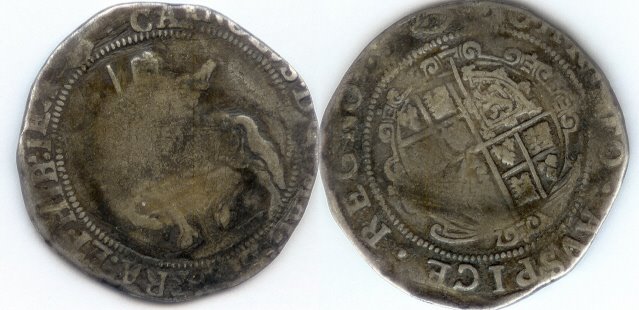
The following two images are a Halfcrown of Charles I Eye Mintmark that dates it to 1645 Tower Mint Under parliament, even though it looks worn, it's in a rather good state for it's age as that at that time because of the war, it was common for the coinage to have problems with the control of standards.

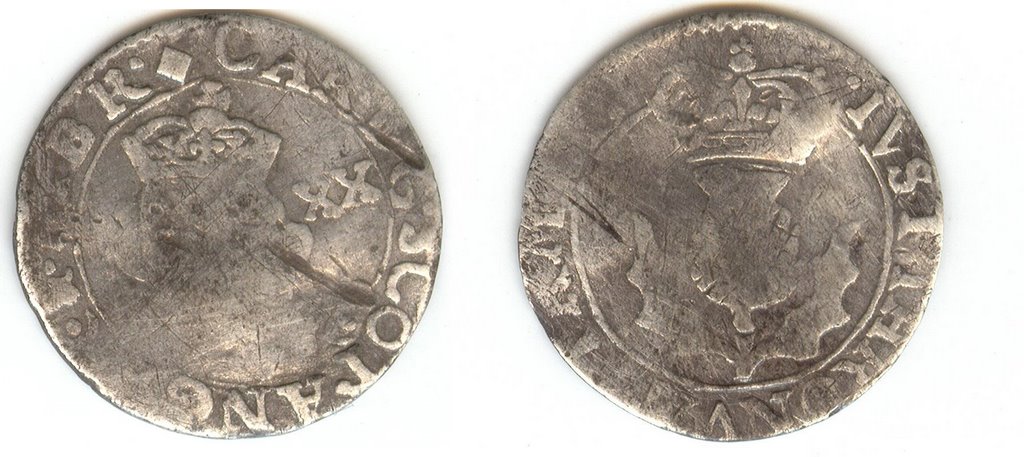
The Second image is of a Charles I Scottish Twenty Shilling, Thistle Mintmark the most probable identification would be Spink 5590 or 5591. Third coinage (1637- 42), bust of new style. My guess is 5590, which is described as 'bust wholly within inner circle, F over crown on rev' or 5591, no F on reverse, but it's difficult to tell due to wear. Even though it's worn it's easy to tell that the quality is better for a hammered coin from this time period, The betterstriking was perhaps a combination of the fact that the Master of the Mint was Nicholas Briot (from 1636 to 1642) and that the coins were produced on a screw press. Later his son-in-law John Falconer took over the role. Some further history can be found below.

Charles I (27 March 1625 - 30 Jan 1649) - born 19 November 1600 - one marriage with nine offspring

Charles I the second son of James I had a weak and sickly childhood and was of quite small stature. He inherited a weak inflationary economy due to the influx of gold and silver from America, and impoverished it by his extravagance. He was deposed for disregarding Parliament, trying to arrest five members and unwisely levying taxes without its consent. This caused the emergence of a radical republican army under the command of Oliver Cromwell. Charles had to leave London relying on traditional Royalist strongholds like Oxford. This means that the coinage of Charles I is one of the most complicated and fascinating in the entire British series, with the great number of provincial Royalist issues and the intriguing Obsidonal coinages from the City’s under siege.

Charles was captured in 1648 and was beheaded at the Mansion House on Whitehall in 1649 aged 48. He famously gave Bishop Juxon a large gold five pound piece as a last act on the scaffold and this has become known as the Juxon Medal and is on display in the British Museum.The reign is one of the most diverse and interesting numismatically ranging from the fine machine made coins of Nicholas Briot to the crudely struck siege pieces of the Civil War struck on old silver plate. Branch Mints were set up around the country starting with Aberystwyth in 1637. The Farthing issues continued under the Duchess of Richmond and Lord Maltravers, finishing in 1644 when the licence was revoked by Parliament.

At the other end of the spectrum were the silver Pounds, the largest British coins ever minted, and the magnificent gold Triple Unites, the largest gold coins ever produced. Many different locations in England and Wales had their own mints throughout the reign and during Civil War. The provincial mints are Aberystwyth, Asbhy, Bridgnorth, Bristol, Chester, Exeter, Hartlebury Castle, Hereford, Oxford, Shrewsbury, Truro, Worcester, York, and the siege mints of Carlisle, Newark, Scarborough and Pontefract. With the large number of mints and denominations coupled with the troubled times during the reign, this equates to an enormous number of different coinages, showing the history and movements of the King in a very unusual period.

Tuesday, September 26, 2006

Elizabeth I (17 Nov 1558 - 24 March 1603) Coinage and History


Over time I hope to post images of some of the coins in my collection and bit of the history around them.


HOUSE OF TUDOR


Elizabeth I (17 Nov 1558 - 24 March 1603) - born 7th September 1533

The Virgin Queen Elizabeth or ‘Gloriana’ un-did Catholic Mary’s work as England reverted to Protestantism and pacified the religious divide. Skilled at politics, she was lucky to be surrounded by talented advisors, but angered them by avoiding the issue of marriage and of course never had children. She assisted Dutch Protestants, and is most famous for defeating her unpopular brother in law, Philip II during the Spanish Armada war of 1588. Her reign is also known for the introduction of the potato and tobacco from the “New World” by Sir Francis Drake. A long and prosperous reign ended in 1603 when Elizabeth died of old age at 75.

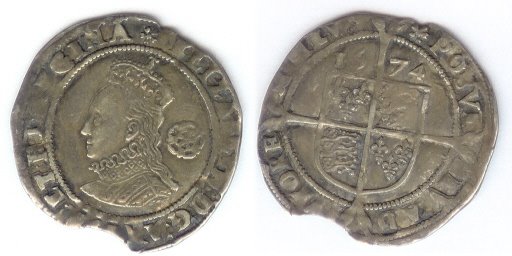
A significant reign for coinage as the first machine made pieces were struck from the presses of the Frenchman Eloye Mestrelle in 1561. However they were not popular as production was slow with the horse drawn mill press, though the quality was very good. Mestrelle was dismissed in 1572 and later executed for his collusion with forgers in 1578 some historians believe this may have been engineered by rivals. Elizabeth enjoyed a long reign and this covered many different denominations being issued at various times. The gold crowns were again issued and it was not till 1600 that the large silver crown was again minted. In 1559 the old debased coins of Edward VI were called in for counter marking at a lower face value and the silver fineness was restored to 0.925 by 1582. A new denomination the three-farthings was introduced to help with small change transactions. The first attempt at international trade coins occurred in 1600-01 with the Portcullis Money for use in the East Indies with weights equivalent to the already popular Spanish trade Reales.

Friday, September 08, 2006

Thracian Dagger 3000 B.C.E


Here is an interesting article about a dagger that was found in Bugaria, it becomes even more fascinating when we consider the metal working knowlege that would have been needed to make it. On another note, this is also the region where a lot of forgerys of ancient coins comes out of.

Thracian Dagger 3000 B.C.E

Ancient dagger found in Bulgaria
By Nick Thorpe BBC News
Archaeologists have discovered a precious golden dagger dated to about 3,000BC in a Thracian tomb in the centre of Bulgaria.
It is the latest find from one of many tombs believed to have formed the cradle of Thracian civilisation.
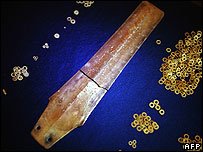
The dagger, made of an alloy of gold and platinum, was found near the village of Dubovo.
Bozhidar Dimitrov, head of Bulgaria's National Museum, told Reuters news agency the discovery was "sensational".
It is the latest in a string of finds in the area in recent years which has excited archaeologists and has provided more details of the skills of the still mysterious Thracian civilisation.
According to officials at the museum, the dagger is 16cm (6in) long and is sharp enough to shave with.
More than 500 other miniature gold items were found in the same tomb.
The detail on the dagger suggests that it was used for sacrificial purposes.
Bloodthirsty
The Thracian civilisation thrived on the edge of the ancient Greek and Roman empires in what is now Bulgaria, Romania, northern Greece and Turkey, and is believed to have lasted up to 4,000 years.
The historian Herodotus described the Thracian as savage, bloodthirsty warriors and provided a description of the elaborate funeral procedures for their rulers.
Other finds in recent years include a gold mask, an ancient Thracian temple, a crown and thousands of items of jewellery.
The alloy used in the latest find suggests a far greater degree of sophistication in metal-working that was previously known for that period.
"This significant find confirmed that people in this region were familiar with what was then high technology in metal processing," Mr Dimitrov told Reuters.