Showing posts with label Queen. Show all posts

Monday, May 21, 2007

Victoria Day

Today is Victoria day a celebration and a Holiday in Canada to remember Queen Victoria's Birthday, as I write this fire works are going off everywhere, it's the first long weekend, though it's been a bit cold, I can't wait for Summer to get here.

Wednesday, March 14, 2007

Elizabeth I (17 Nov 1558 - 24 March 1603) Coinage and History


This is another part in the coinage and history series, I fear I have been somewhat slow with the release of posts with this, though a lot is dependent, on when I purchase new coins. I have also been experimenting with Photographing the coins as opposed to scanning them to get the best image.

The picture above is of a Shilling from Elizabeth I it is from the year 1560-1561 Mintmark-Cross-Spink-2555-A. The Obverse portrait side may look the worse for wear, but it was very common with the larger coins for them to be weakly struck. So this is still a very nice example given that it has not been clipped, another practice that was very common. The practice of clipping is very much what it sounds like, people would clip small potions of the sliver off of the coin, pretty much whatever they felt they could get away with.

This coin is also interesting as it was minted at the start of Elizabeth I great recoinage of the realm, as the coinage under her Brother Edward VI, and Her Father Henry VIII had been debased mostly under Henry VIII, in order for him to finance his wars and household, This is where Henry The VIII received the nickname old Coppernose from, as the silver would wear away on the high points of the coin and reveal the base metal, most offten than not on the nose first.

At this time when Elizabeth, was still very early into her queenship, The Tudor house was not in great financial shape as the spending under her father and mismanagement had sorely pressed the royal coffers. Elizabeth I though had been very good at managing her estates, so she used the funds from them to finance the recoinage, just one other little thing of interest Elizabeth I also used some of the royal households silver service to be melted down and used in the recoinage as well. You will find below some more information on The House Of Tudor. I hope you have enjoyed this and please feel free to leave any comments or feedback you may have.

HOUSE OF TUDOR

Elizabeth I (17 Nov 1558 - 24 March 1603) - born 7th September 1533The Virgin Queen Elizabeth or ‘Gloriana’ un-did Catholic Mary’s work as England reverted to Protestantism and pacified the religious divide. Skilled at politics, she was lucky to be surrounded by talented advisors, but angered them by avoiding the issue of marriage and of course never had children. She assisted Dutch Protestants, and is most famous for defeating her unpopular brother in law, Philip II during the Spanish Armada war of 1588. Her reign is also known for the introduction of the potato and tobacco from the “New World” by Sir Francis Drake.


A long and prosperous reign ended in 1603 when Elizabeth died of old age at 75.A significant reign for coinage as the first machine made pieces were struck from the presses of the Frenchman Eloye Mestrelle in 1561. However they were not popular as production was slow with the horse drawn mill press, though the quality was very good. Mestrelle was dismissed in 1572 and later executed for his collusion with forgers in 1578 some historians believe this may have been engineered by rivals. Elizabeth enjoyed a long reign and this covered many different denominations being issued at various times.


The gold crowns were again issued and it was not till 1600 that the large silver crown was again minted. In 1559 the old debased coins of Edward VI were called in for counter marking at a lower face value and the silver fineness was restored to 0.925 by 1582. A new denomination the three-farthings was introduced to help with small change transactions. The first attempt at international trade coins occurred in 1600-01 with the Portcullis Money for use in the East Indies with weights equivalent to the already popular Spanish trade Reales.

Wednesday, October 11, 2006

Victoria (20 June 1837 - 22 January 1901)


Here is an example of a Jubilee Shilling from 1887 of Queen Victoria Spink Number 3926 Small Head some additional information can be found below.

HOUSE OF HANOVER

Victoria (20 June 1837 - 22 January 1901) - born 24th May 1819 - one marriage with nine offspring


Victoria was granddaughter of George III, the daughter of his fifth son Edward. Her father Edward died while she was in infancy, but her mother Victoria of Saxe-Coburg-Saalfeld brought her up under a strict regimen that stood her in good stead to be Queen upon the death of her Uncle William. A Royal wedding took place on 10 February 1840 to Prince Albert of Saxe-Coburg-Gotha, with whom she had four sons and five daughters, all of whom married into some of the finest Royal families in Europe. Victoria was devastated by the death of her beloved Albert in 1861 from typhoid and never really recovered, known as the “Widow of Windsor” in seclusion for 25 years until she emerged for her Golden Jubilee. During the seclusion Victoria also became Empress of India in 1878.

Victoria enjoyed the longest reign so far of any monarch and saw her Diamond Jubilee in 1897, the only time this has occurred in British history so far. The Industrial Revolution was now in full force, the zenith of which was the Great Exhibition of 1851. Victoria built up the greatest Empire ever seen since the days of the Ancient Romans. There were many technological revolutions with the harnessing of electricity perhaps most significant, also the invention of the telephone and motor transport, as well as the massive growth of railways and shipping and science. Magnificent architecture from the Victorian era not only transformed London, but also cities as far apart as Sydney and Delhi, Hong Kong and Singapore.

Victoria died aged 81 with her family gathered around her at Osbourne House on the Isle of Wight after a 63 year reign, her body was brought back to the Capital by the Royal Train. Her long reign produced some fascinating coinage and many different busts were used for the various Colonial coinages. Branch Mints opened in Australia, first in Sydney then Melbourne, and much later at Perth. There were attempts at decimalization during her reign and the biggest successful move towards this was the introduction of the Florin or one tenth of a pound in 1848.


Some of the finest designs were by William Wyon for the 1839 gold Five Pounds coin used in that year’s proof set and later for the 1847 Gothic Crown. The Wyon family dominated coin and medal production for the earlier part of Victoria’s reign, J E Boehm engraved the Jubilee coinage of 1887, and Thomas Brock the “widow” old head coinage of 1893.

Tuesday, September 26, 2006

Elizabeth I (17 Nov 1558 - 24 March 1603) Coinage and History


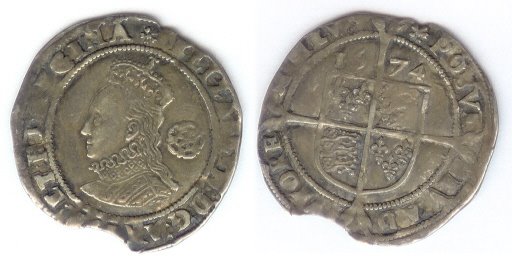
Over time I hope to post images of some of the coins in my collection and bit of the history around them.


HOUSE OF TUDOR


Elizabeth I (17 Nov 1558 - 24 March 1603) - born 7th September 1533

The Virgin Queen Elizabeth or ‘Gloriana’ un-did Catholic Mary’s work as England reverted to Protestantism and pacified the religious divide. Skilled at politics, she was lucky to be surrounded by talented advisors, but angered them by avoiding the issue of marriage and of course never had children. She assisted Dutch Protestants, and is most famous for defeating her unpopular brother in law, Philip II during the Spanish Armada war of 1588. Her reign is also known for the introduction of the potato and tobacco from the “New World” by Sir Francis Drake. A long and prosperous reign ended in 1603 when Elizabeth died of old age at 75.

A significant reign for coinage as the first machine made pieces were struck from the presses of the Frenchman Eloye Mestrelle in 1561. However they were not popular as production was slow with the horse drawn mill press, though the quality was very good. Mestrelle was dismissed in 1572 and later executed for his collusion with forgers in 1578 some historians believe this may have been engineered by rivals. Elizabeth enjoyed a long reign and this covered many different denominations being issued at various times. The gold crowns were again issued and it was not till 1600 that the large silver crown was again minted. In 1559 the old debased coins of Edward VI were called in for counter marking at a lower face value and the silver fineness was restored to 0.925 by 1582. A new denomination the three-farthings was introduced to help with small change transactions. The first attempt at international trade coins occurred in 1600-01 with the Portcullis Money for use in the East Indies with weights equivalent to the already popular Spanish trade Reales.