Showing posts with label Gold. Show all posts

Thursday, March 19, 2009

Odyssey Marine Shipwreck Holds 200,000 Gold Coins


Odyssey Marine has started work on another shipwreck that could hold about four tons of gold the full story follows below.

Odyssey Marine, the southern Florida shipwreck experts that have found more coin treasures than any other salver, has discovered the wreck of HMS Victory, it was announced Feb 2.

HMS Victory sank in the English Channel on Oct. 4, 1744, taking 1,150 sailors and four tons of Portuguese gold to the bottom of Davy Jones' locker.

About 200,000 gold coins are believed to be part of the treasure, whose sinking caused a major embarrassment to King George II in 1744, and whose recovery in 2009 could well become a cause celebre in international legal circles.

The wreckage of the HMS Victory, found below about 330 feet of water, may carry an even bigger jackpot than the $500 million in sunken treasure discovered two years ago off the coast of Spain.

Research indicates the HMS Victory was carrying 4 tons of gold coins when it sank in storm, said Greg Stemm, co-founder of Odyssey Marine Exploration, ahead of a Feb. 2 news conference in London.

So far, two brass cannons have been recovered from the wreck, Stemm said. The Florida-based company said it is negotiating with the British government over collaborating on the project.

"This is a big one, just because of the history,'' Stemm said. "Very rarely do you solve an age-old mystery like this.''

Thirty-one brass cannons and other evidence on the wreck allowed definitive identification of the HMS Victory, the 175-foot (53-meter) sailing ship that was separated from its fleet and sank in the English Channel on Oct. 4, 1744, with at least 900 men aboard, the company said. The ship was the largest and, with 110 brass cannons, the most heavily armed vessel of its day. It was the inspiration for the HMS Victory famously commanded by Adm. Horatio Nelson decades later.

Odyssey was searching for other valuable shipwrecks in the English Channel when it came across the Victory. Stemm wouldn't say exactly where the ship was found for fear of attracting plunderers, though he said it wasn't close to where it was expected.

"We found this more than 50 miles (80 kilometers) from where anybody would have thought it went down,'' Stemm said.

Federal court records filed by Odyssey in Tampa seeking the exclusive salvage rights said the site is 25 miles to 40 miles (40 kilometers to 64 kilometers) from the English coast, outside of its territorial waters. Odyssey Marine has previously discovered vessels with treasure that sailed under the flags of Spain, Peru, England and others.

In order to assert ownership, Odyssey Marine commenced an action in the U.S. District Court for the Middle District of Florida, located in Tampa. The technical term is to "arrest" the vessel, a principal whereby the salver recovers some portion of the ship or its cargo and brings it before the court. In this case, it was a brass cannon.

The Victory - the same name was used for Lord Nelson's shop at Trafalgar generations later - is only called an "Unidentified vessel" in the title of the complaint, the better to confuse those who might seek to take the treasure from under the noses of the competition - other treasure salvers.

Odyssey's claims for salvage rights for other vessels were asserted under either international law of the sea or the law of salvage, which sometimes conflict. They are litigating against the Kingdom of Spain and Republic fo Peru over Spanish galleons found after a shipwreck in the 17th century.

English shipwrecks have a common law background, different from the civil law of Spanish countries, which reserve treasure to the sovereign - and provide that it cannot be salvaged without the consent of Her Majesty's government. On another less important wreck, Odyssey got to keep 80 percent of the first $50 million in salvage value on a diminishing scale until above $500 million the profits would be split 50-50.

Under international maritime law and the law of the sea, going back to the time of Hugo Grotius in the year 1600, when an owner of a vessel abandons it, it may be claimed by anyone who finds it. When it is not abandoned, a wreck may be salvaged by anyone who claims it ("arrests" the wreck, in the arcane language of admiralty law).

They may not necessarily be able to keep the goods, but must be compensated for the salvage work that they have done the payment can be quite liberal - if there is a right to work the vessel and its treasure in the first place.

In most instances, available technology at the time the ships surrendered to the depths limited the ability to salvage the ships, rescue persons or property. The situation with the Mercedes (another Odyssey litigation with Spain) is also similar to more than 600 other Spanish wrecks that are known to have populated the East Coast of the United States.

This very factor, and the wreck of other ships, prompted the U.S. Congress in 1987 to try and regulate control over the marine tragedies that took place inside the three-mile limit. Essentially, they were ruled to be owned by the United States, which in turn delegated the ownership to the individual states.

The Victory is located in the English Channel, about 60 miles from its last reported position which solved a historical mystery - and Odyssey claims that no nation has the right to regulate who can salvage it. The British Foreign Office disagrees.

Regardless of the state or nation involved, the general principals of law are essentially the same. When sunken ships or their cargo are rescued from the bottom of the ocean by those other than the owners, courts generally favor applying the law of salvage over the law of finds.

"Finds" can be summed up by that childish taunt, "Finder's keepers".

Finds law is generally applied, however, where the previous owners are found to have abandoned their property. Abandonment must be proved to the Court's satisfaction by clear and convincing evidence, typically by an owner's express declaration abandoning title. (It can be proved indirectly through actions, too).

In some instances, a commercial shipments of gold may be insured, and the underwriters are usually asked to promptly pay the claims. The payment of the claims vests title to the gold in the underwriters, who can no more salvage the boat than the government can.

The position of the Department of State, as expressed in a Report of the House of Representatives in 1988 is that "the U.S. only abandons its sovereignty over, and title to, sunken U.S. warships by affirmative act; mere passage of time or lack of positive assertions of right are insufficient to establish such abandonment."

A 1902 treaty of friendship and commerce with Spain provided the key that the Court will look to: "Spanish vessels can ... be abandoned only by express renunciation. Both Spain and the United States agree that this treaty provision requires that in our territorial waters Spanish ships are to be accorded the same immunity as United States.

So the shipwreck of the century is headed to Tampa and court, where it will all be sorted out in the coming months. Meanwhile, the salvers will be looking for the coins that they know are on board, under 300 feet of the English channel and many pages of history.


Digg!

Saturday, May 19, 2007

Shipwreck Treasure Found Part II


It looks like the secracy will go one for a bit here is a report for today where they speculate that the shipwreck find was off the coast of Corwall, so now we have two places either off the coast of Flordia or Corwall another interesting thing was the stock for the company clossed out yesterday up by Eighty Percent.


Odyssey Marine Exploration Stock

So all in all this is going to be fun to follow.


Record wreck 'found off Cornwall'

The haul was salvaged using a tethered underwater robot

The haul of coins

A record haul of half a million silver and gold coins from a 17th Century shipwreck may have been found just 40 miles from Land's End, an expert said.
US treasure hunters said the coins, worth an estimated $500m (£253m), were recovered in the Atlantic Ocean.

But Odyssey Marine Exploration, who described it as the largest find of its kind, refused to pinpoint the location.

US coin expert Dr Lane Brunner said there was evidence the shipwreck was lying off the Cornish coast.

Dr Brunner, from the American Numismatic Association, told Five Live there were clues about the location in a statement given to a US federal court in the autumn.

"They told a judge at that point that they had found the wreck of a seventeenth-century merchant ship in the Atlantic Ocean, just outside the English Channel - about 40 miles off Lands' End.


So all we can do is add two and two together
Dr Lane Brunner


"So all we can do is add two and two together. It would seem logical given the timing and everything that could be the site."

In 1641, an English ship called the Merchant Royal sank off the Scilly Islands, laden with bullion from Mexico. There is speculation that this is the wreck salvaged by Odyssey.

'Dazzling specimens'

Odyssey said it had kept the location secret because of security and legal reasons.

"The gold coins are almost all dazzling mint state specimens," Odyssey co-founder Greg Stemm said.

The artefacts, including more than 17 tonnes of silver coins plus a few hundred gold coins, have been shipped to the US and are being examined by experts at an undisclosed location.


The mammoth haul was salvaged using a tethered underwater robot.

Odyssey, which used the code name Black Swan, said it expected the wreck to become one of the "most publicised in history".

It said the site was of huge historical importance because of the insight it would offer into seafaring and the social life of the period when the ship sank.

"Our research suggests that there were a number of colonial period shipwrecks that were lost in the area where this site is located, so we are being very cautious about speculating as to the possible identity of the shipwreck," said John Morris, Odyssey's co-founder.

"We have treated this site with kid gloves and the archaeological work done by our team out there is unsurpassed.

"We are thoroughly documenting and recording the site, which we believe will have immense historical significance," he said.

Odyssey said the coins were recovered in international waters, "beyond the legal jurisdiction of any country", and had been legally imported into the US.

Tuesday, October 03, 2006

Treasure Trove Warning Over E-Bay

Treasure Trove Warning Over E-Bay

This story I found to be interesting as it could have a very big effect on what we may see for auction in the future, as I'm not sure how many people knew of the law and I don't think it was really being enforced.

People who find treasure may be breaking the law if they do not report it to the authorities, eBay and the British Museum are warning.
The museum has set up a specialist team - under its Portable Antiquities Scheme (PAS) - to make sure antiques are legally sold by eBay sellers.
Some traders in archaeological finds are unaware they may have to be declared under the Treasure Act.

Illegal listings will be reported to specialist Met Police detectives.
English, Welsh and Northern Irish archaeological finds which constitute "treasure" must be reported to the local coroner or the PAS under the Treasure Act.
Metallic objects made up of at least 10% gold or silver which are at least 300 years old are classed as treasure.

"There are definitely some people who know perfectly well what they're doing" British Museum


Some coins with lower amounts of gold or silver could also be classed as treasure.
Failure to report finds deemed to be treasure is a criminal offence under the act.
Items spotted by the PAS being sold on eBay illegally have included gold and silver Roman rings.

Staff from PAS - which is run by the British Museum on behalf of the Museums, Libraries and Archives Council (MLA) - will contact sellers to make sure they have reported items and are entitled to offer them for sale.

The British Museum's Roger Bland told BBC News: "There are definitely some people who know perfectly well what they're doing. They're selling finds on a regular basis all the time.
"But when we contact people who are selling objects we think should be reported as treasure there's quite a few more who I think genuinely do it out of ignorance because they don't know about the law."

'Valuable insights'

Chris Batt, chief executive of the MLA, said the partnership would mean illegal listings could be stopped and action taken.
"Doing so is vital because such activity is not only illegal but could also damage the archaeological record as, without effective reporting, valuable insights into our past could be lost forever," he said.

An eBay spokesman said educating its customers "on what to look out for when buying antiquities on eBay and informing sellers of their obligations is of paramount importance".
As part of the joint initiative, the site has created a guide to buying and selling antiquities which offers advice on reporting obligations.

Under the Treasure Act, metallic objects made up of at least 10% gold or silver which are at least 300 years old must be reported to the local coroner or the PAS.
Some coins with lower amounts of gold or silver could also be classed as treasure.
Items spotted by the PAS being sold on eBay illegally have included gold and silver Roman rings.


Story from BBC NEWS:http://http://news.bbc.co.uk/2/hi/uk_news/5401588.stm

Friday, September 29, 2006

Shipwrecks, Coins And Salvage

Shipwrecks, Coins And Salvage


I found this to be an intriguing story, and it brings about some interesting questions about the rights of salvage, ownership and Sovereignty over underwater archaeological sites. Thats just the legal problems, it's also fascinating in the history around it and how it got there.


N.S. shipwreck discovery brews international storm

Randy Boswell
CanWest News Service
An American shipwreck hunter has found "thousands of coins" and other artifacts at a site off the coast of Nova Scotia where a War of 1812 gunboat thought to be carrying White House plunder sank in a storm on its return to Canada after the ransacking of Washington.
But the discovery, the strongest sign yet that Philadelphia-based Sovereign Exploration Associates may have discovered the remains of the legendary British frigate HMS Fantome or other ships from its fleet, sets the stage for a possible international legal showdown involving the salvage company, the British government and heritage officials in Canada and the U.S. over the future of the wreck site.
CanWest News Service has learned the British government has asked Canada to halt exploration at the possible Fantome site and insisted that nothing should be taken from the area without permission from London.
Wendy Barnable, a spokesperson with the Nova Scotia government's Ministry of Tourism, Culture and Heritage, said Wednesday the province has received a letter, via federal officials in Ottawa, in which Britain argues that the Fantome -- along with a sunken 18th-century British treasure ship, HMS Tilbury, also being sought by Sovereign off the Cape Breton coast -- "remain the property of the British government and can't be disturbed without their consent."
Describing the British intervention as unprecedented, Barnable said provincial heritage officials are studying the "very complex" issue and have, in the meantime, advised the U.S. salvager to seek British approval to continue its explorations.
In a statement announcing its latest finds, Sovereign said: "Our divers observed flatware, artifacts, ship fittings and thousands of coins. While our science team has not positively identified the vessels on the site, the new data combined with last year's recoveries . . . clearly establish the site as one of significant historical importance."
The search for the Fantome has been controversial and jurisdictionally complex because the British wreck lies in Canadian waters but is believed to hold gold and other treasures looted during a famous 1814 raid on the White House, treasury headquarters and other buildings in the U.S. capital. The same naval operation also inspired the "bombs bursting in air" imagery of The Star-Spangled Banner, the U.S. national anthem

Thursday, September 28, 2006

Charles II (30 Jan 1649 - 6 Feb 1685) Coinage And History


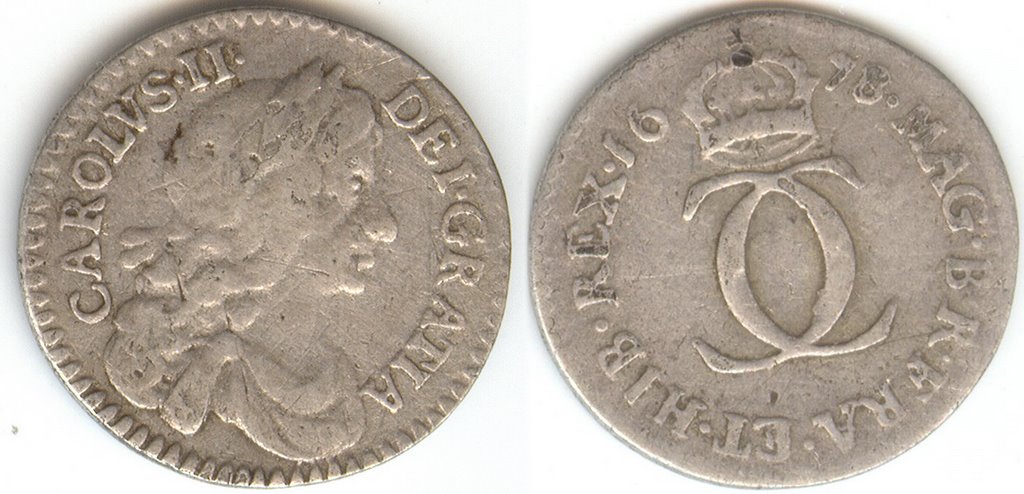
As yesterday, I Showed some Charles I coins, I thought it would make some sense to show one from when his son Charles II was restored to The Monarchy. The following coin is a Charles II twopence from 1678 along with some background information.


HOUSE OF STUART


Charles II (30 Jan 1649 - 6 Feb 1685) - born 29th May 1630 - one marriage with no offspring


Several ill fated attempts to regain his inheritance from his father failed, as his armies were routed by the well organised Cromwell. A young Charles had to flee the country as the power of the Commonwealth steadily but surely took over, famously hiding in an oak tree en route to France. The restoration of the monarchy was negotiated by General George Monk who called for new elections, following a revival of royalist feeling in 1660. Charles II ascended to the throne after being recalled from his exile and the Restoration began on 29th May 1660. He was married in 1662 to Catherine Henrietta daughter of John IV Duke of Braganza, but failed to produce an heir. He did have sixteen illegitimate issue though after amorous affairs with various women including Nell Gwynn and Louise, duchess of Portsmouth. Charles was a keen horseman and actually rode several winners at Newmarket himself. He died aged 54 from complications following a stroke.

His reign was most important numismatically for the permanent introduction of machine made “milled” coinage from 1662 and for the introduction of a copper regal coinage of halfpennies and farthings from 1672 after the withdrawal of tradesman’s tokens. The hammered coinage finished being produced in early 1662, and the Roettier family designed the new coinage replacing Thomas Simon who was relegated to designing only the small silver coins and medallions. The major new milled denomination was the Guinea with it’s multiples and fractions which was valued at this time at twenty shillings. The silver denominations were the same as for Cromwell with the Sixpence in addition with the small silver from groat to penny. Some of the silver shillings have a plume on the centre of the reverse sometimes with a plume on the obverse as a mint mark, this indicates the silver came from Wales. Some of the gold coinage has an elepant below the bust indicating the gold came from Guinea in Africa.

Friday, September 08, 2006

Thracian Dagger 3000 B.C.E


Here is an interesting article about a dagger that was found in Bugaria, it becomes even more fascinating when we consider the metal working knowlege that would have been needed to make it. On another note, this is also the region where a lot of forgerys of ancient coins comes out of.

Thracian Dagger 3000 B.C.E

Ancient dagger found in Bulgaria
By Nick Thorpe BBC News
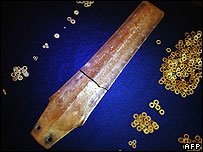
Archaeologists have discovered a precious golden dagger dated to about 3,000BC in a Thracian tomb in the centre of Bulgaria.
It is the latest find from one of many tombs believed to have formed the cradle of Thracian civilisation.
The dagger, made of an alloy of gold and platinum, was found near the village of Dubovo.
Bozhidar Dimitrov, head of Bulgaria's National Museum, told Reuters news agency the discovery was "sensational".
It is the latest in a string of finds in the area in recent years which has excited archaeologists and has provided more details of the skills of the still mysterious Thracian civilisation.
According to officials at the museum, the dagger is 16cm (6in) long and is sharp enough to shave with.
More than 500 other miniature gold items were found in the same tomb.
The detail on the dagger suggests that it was used for sacrificial purposes.
Bloodthirsty
The Thracian civilisation thrived on the edge of the ancient Greek and Roman empires in what is now Bulgaria, Romania, northern Greece and Turkey, and is believed to have lasted up to 4,000 years.
The historian Herodotus described the Thracian as savage, bloodthirsty warriors and provided a description of the elaborate funeral procedures for their rulers.
Other finds in recent years include a gold mask, an ancient Thracian temple, a crown and thousands of items of jewellery.
The alloy used in the latest find suggests a far greater degree of sophistication in metal-working that was previously known for that period.
"This significant find confirmed that people in this region were familiar with what was then high technology in metal processing," Mr Dimitrov told Reuters.